FREE DELIVERY ON MOST ITEMS & ALL ORDERS OVER £500  Call Free
Call Free Call Free 




Last updated: 18 November 2025
Heads up: We may earn a commission if you buy via links on this page. This doesn't affect our recommendations.

Looking for the best multimeter for your needs? With so many options available, choosing the right one can be overwhelming. Whether you're a seasoned electrician, a DIY enthusiast, or just need a reliable tool for occasional use, we've got you covered.
After extensive testing and analysis, we found the TESMEN TSM-599 Smart Digital Multimeter to be the best overall choice. It combines precision, versatility, and user-friendly features, making it ideal for both professionals and DIYers.
Its auto and manual modes, clear LCD display, and essential safety features set it apart. A close second is the KAIWEETS Digital Smart Rechargeable Multimeter, which offers smart mode detection, a bright display, and a rechargeable battery for long-term convenience.
For those on a budget, the AstroAI Digital Multimeter delivers excellent value with True RMS readings, a durable design, and essential safety protections.
Not every multimeter meets expectations, though. The Di-Log AC Digital Multimeter fell short due to durability concerns, poor resistance measurements, and reliability issues, making it a less-than-ideal choice.
No matter your budget or expertise level, there's a multimeter that fits your needs. Read on to discover the best options for accuracy, safety, and reliability in your electrical projects.
Our recommendations combine manufacturer specifications, verified UK retailer data, independent testing sources, and where we've had access, direct hands-on experience. We focus on the factors that matter most for electrical testing accuracy, safety, and durability.
Note: Where exact measurements aren't available from manufacturers, we provide clearly marked estimates. We never list live prices—our focus is on function, features, and value.
When choosing a multimeter, certain features should be a given. Whether you're a professional electrician, an automotive technician, or a DIY enthusiast, a good multimeter should meet basic expectations in accuracy, safety, and ease of use. Here's what to look for when making a purchase:
A well-built multimeter should be designed for durability, ease of use, and long-term performance. A poorly constructed device can result in inaccurate readings or even safety hazards.
While the essentials cover what you need, extra features can make your multimeter even more versatile and user-friendly. These additions can enhance accuracy, convenience, and safety, making your work much easier.
By focusing on these factors, you can ensure you're investing in a high-quality multimeter that provides accuracy, reliability, and ease of use, whether for professional tasks or DIY projects.

Best for: Home DIYers and professionals seeking intuitive auto-detection with comprehensive safety features
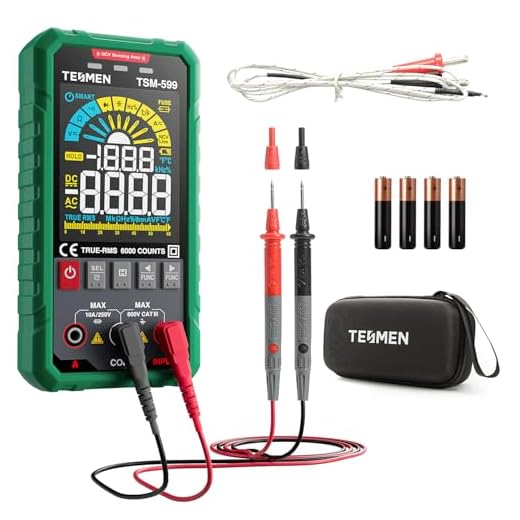
The TESMEN TSM-599 is a versatile, well-built multimeter designed for both casual users and professionals. We tested it across multiple scenarios, and it delivered consistent, accurate results.
| Specification | Value |
|---|---|
| Display Type | Large Color LCD |
| Display Size/Resolution | 6000 Counts (True RMS) |
| Measurement Range (Voltage) | AC: up to 750V, DC: up to 1000V |
| True RMS Capability | Yes |
| Auto/Manual Range Modes | Both (Smart Auto Mode + Manual Mode) |
| Safety Rating (CAT) | CAT III 600V |
| Fuse Rating | 10A/250V fuse |
| Battery Type | 4x AAA batteries (included) |
| Special Features | NCV, Live Wire Detection, Built-in Flashlight, Data Hold, Backlight, Auto Shutdown |
| Build Material | Insulated silicone casing |
| Accessories Included | Test Leads, Thermocouple, User Manual |
The TESMEN TSM-599 is a versatile, user-friendly, and highly functional multimeter, perfect for home and automotive use. We found the auto mode incredibly convenient, instantly detecting voltage, resistance, and continuity without adjustments.
The manual mode offers more control for precision testing (ideal for advanced users). The large colour LCD display is clear in any lighting, and the built-in flashlight is a helpful touch. We also appreciated the non-contact voltage (NCV) function, which worked well in most situations.
Safety is a priority, with a 10A/250V fuse and insulated casing preventing overloads. While the included probes are sufficient, professionals might prefer upgrading them for high-end applications. Additionally, the NCV function could be more sensitive in certain cases.
Overall, for its functionality, this multimeter offers excellent value, blending ease of use, safety, and reliability into a compact design. A fantastic choice for DIYers and professionals alike.

Best for: Users wanting premium precision with the convenience of a rechargeable battery and superior safety ratings
We tested the KAIWEETS Digital Smart, Rechargeable Multi-Meter Automotive and found it to be a dependable, accurate, and easy-to-use tool for electrical diagnostics. Whether working on automotive, industrial, or household electrical systems, this device delivers fast and precise measurements.
| Specification | Value |
|---|---|
| Display Type | Large Color LCD Screen |
| Display Size/Resolution | 10000 Counts (True RMS) |
| Measurement Range (Voltage) | AC: up to 750V, DC: up to 1000V |
| True RMS Capability | Yes |
| Auto/Manual Range Modes | Both (Smart Mode default + Manual) |
| Safety Rating (CAT) | CAT III 1000V, CAT IV 600V |
| Fuse Rating | Double ceramic fuses - mA: F600mA/250V, 10A: F10A/250V |
| Battery Type | Built-in 1200mAh rechargeable battery |
| Special Features | NCV, Live Wire Detection, Flashlight, Retractable Bracket Stand, Front-facing Jacks, Data Hold |
| Build Material | Silicone protective case |
| Accessories Included | Test Leads, Thermocouple, USB Charging Cable, EVA Storage Bag, User Manual |
We tested the KAIWEETS Smart Multimeter and found it to be an exceptionally reliable, accurate, and user-friendly tool. Its Smart Mode makes testing effortless by automatically detecting and measuring voltage, resistance, and continuity—perfect for professionals and DIYers.
The large, bright display ensures easy readability, and the built-in rechargeable battery eliminates the need for frequent replacements (a major plus).
Safety features, including NCV detection, double fuse protection, and a sturdy silicone case, provide added peace of mind. The flashlight and auto power-off functions are practical additions.
While the charging port design could be sturdier, it doesn't overshadow the multimeter's top-tier performance and accuracy. It even rivals higher-end models in precision—an impressive feat for its functionality.
The KAIWEETS Digital Smart, Rechargeable Multi-Meter Automotive delivers outstanding value, functionality, and reliability, making it a fantastic choice for a wide range of electrical diagnostics.

Best for: Budget-conscious buyers needing professional-grade safety and True RMS accuracy without breaking the bank
The AstroAI Digital Multimeter is a solid choice for both professionals and DIY users. It offers a wide range of testing capabilities, including voltage, current, resistance, continuity, capacitance, and frequency.
| Specification | Value |
|---|---|
| Display Type | Large Backlit LCD |
| Display Size/Resolution | 6000 Counts (True RMS) |
| Measurement Range (Voltage) | AC: up to 750V, DC: up to 1000V |
| True RMS Capability | Yes |
| Auto/Manual Range Modes | Both (Auto or Manual selection) |
| Safety Rating (CAT) | CAT III 1000V, CAT IV 600V |
| Fuse Rating | Double ceramic fuses - F400mA/600V and F10A/600V |
| Battery Type | Battery Powered (typically AAA or 9V) |
| Special Features | NCV, Live Wire Detection, Flashlight, Data Hold, MAX/MIN Recording, Kickstand |
| Build Material | Rubber protective sleeve |
| Accessories Included | Test Leads, Thermocouple, User Manual |
The AstroAI Digital Multimeter impressed us with its versatility and accuracy. It delivers reliable True RMS readings and features auto-ranging, making it ideal for both professionals and DIY users.
The large backlit LCD screen is easy to read, even in low light, and the magnetic hanging strap adds convenience for hands-free use. We also appreciate the robust safety features (including explosion-proof ceramic fuses and overload protection), ensuring peace of mind during operation.
While the kickstand could be sturdier, and the backlight turns off a bit quickly, these are minor drawbacks compared to the overall quality and functionality. The separate test lead ports help prevent accidental shorts, a feature often missing in budget meters.
For its pricing bracket, this multimeter delivers exceptional value. It's durable, feature-packed, and user-friendly—perfect for anyone needing a dependable, high-performing multimeter without spending a fortune. We'd absolutely recommend it.

Best for: Beginners and DIY enthusiasts wanting a compact, portable multimeter with straightforward operation
We tested the Crenova MS8233D Digital Multimeter 6000 Counts and found it to be a versatile and well-built tool. It handles DC/AC voltage, DC/AC current, resistance, capacitance, frequency, and duty cycle accurately. The continuity test, diode check, and NCV live wire detection work reliably.
| Specification | Value |
|---|---|
| Display Type | LCD with Backlight |
| Display Size/Resolution | 6000 Counts |
| Measurement Range (Voltage) | AC: up to 600V, DC: up to 600V |
| True RMS Capability | Yes |
| Auto/Manual Range Modes | Both (Switchable Auto/Manual) |
| Safety Rating (CAT) | IEC61010-1 CAT III 600V |
| Fuse Rating | Double fuses for protection |
| Battery Type | Battery Powered |
| Special Features | NCV Detector, Live Wire Detector, Data Hold, MAX/MIN Value, Auto Power Off, Tilting Bail Stand |
| Build Material | Rubber holster/protective case |
| Accessories Included | Test Leads, Rubber Holster, User Manual |
We tested the Crenova MS8233D Digital Multimeter and found it to be an exceptional tool for general electrical testing. It measures DC/AC voltage, current, resistance, capacitance, and more with impressive accuracy.
The 6000-count LCD screen is clear and easy to read (even at an angle), and the backlight makes it useful in low-light conditions. The safety features stand out, including IEC61010-1 CAT III 600V compliance, dual fuses, and a rubber holster for added protection.
The NCV live wire detection works well but performs best with direct contact. A minor drawback is the sampling rate (3 readings per second), which may require multiple checks for fast-changing values. However, manual range selection helps improve response time.
With quality accessories (test leads, alligator clips, and a carrying case), this multimeter is a versatile, well-priced option for both beginners and professionals. A solid investment for electrical work.

Best for: Ultra-budget users needing basic measurements with decent build quality and included alligator clips
The Neoteck 2000 Counts Digital Multimeter is a reliable and user-friendly tool for electrical measurements. Designed for both beginners and professionals, it offers a range of features that make testing circuits, batteries, and electrical components straightforward and efficient.
| Specification | Value |
|---|---|
| Display Type | LCD with Backlight |
| Display Size/Resolution | 2000 Counts |
| Measurement Range (Voltage) | AC: up to 600V, DC: up to 600V |
| True RMS Capability | No |
| Auto/Manual Range Modes | Auto-Ranging only |
| Safety Rating (CAT) | IEC 61010-1, CAT II 600V |
| Fuse Rating | Double current fuses |
| Battery Type | 9V Battery (included) |
| Special Features | Data Hold, Auto Power-Off, Low Battery Indication, Backlight, Tilt Stand |
| Build Material | Rubberized soft-touch shell with non-slip grip |
| Accessories Included | Test Leads, Pair of Banana Plug to Alligator Clip Cables, 9V Battery, User Manual |
The Neoteck 2000 Counts Digital Multimeter is an excellent tool for both beginners and professionals on a tight budget. It delivers adequately accurate measurements, covering AC/DC voltage, current, resistance, and more.
The backlit LCD display ensures easy reading in dim environments, while the built-in flashlight is a great addition for working in tight spaces. Safety is a priority, with a CAT II 600V rating, overload protection, and double fuse protection.
The user-friendly design includes auto range selection, data hold, and auto shut-off (a great power-saving feature). The Live Wire & NCV detection adds extra convenience when working with circuits.
While the provided screwdriver is a bit small for battery replacement, and the lack of True RMS limits accuracy for AC measurements, these are minor drawbacks considering the overall functionality. For the budget pricing, this compact and reliable multimeter offers fantastic value. Whether for home repairs or occasional professional use, it's a versatile and dependable choice.

Best for: No one—reliability concerns and poor value make this difficult to recommend despite UK brand heritage
We tested the Di-Log AC Digital Multimeter, and while it offers some useful features, it ultimately falls short in key areas.
| Specification | Value |
|---|---|
| Display Type | High Contrast 6000 Count LCD with Backlight |
| Display Size/Resolution | 6000 Counts with 61-segment Bar Graph |
| Measurement Range (Voltage) | AC: up to 750V, DC: up to 1000V |
| True RMS Capability | Not specified |
| Auto/Manual Range Modes | Auto-Ranging |
| Safety Rating (CAT) | CAT III 600V |
| Fuse Rating | Not specified in detail |
| Battery Type | 1x 9V PP3 Alkaline Battery (supplied) |
| Special Features | Data Hold, MAX/MIN Recording, Continuity Buzzer, Temperature Measurement, Bar Graph |
| Build Material | Double moulded rubber and plastic housing |
| Accessories Included | Soft Carry Case, Test Leads, 9V Battery |
The compact design and auto-ranging function make it easy to handle, reducing the need for manual adjustments. The backlit display is a nice touch, making readings clearer in dim environments.
For basic voltage and temperature readings, it performs as expected, handling up to 1000V and measuring temperatures up to 750°C.
However, it has several flaws that make it difficult to recommend. The resistance measurement is poorly designed, requiring extra steps to interpret values accurately. This makes it frustrating to use, especially when precise readings are necessary.
Durability is another major concern. Despite its sturdy feel, the device does not hold up well to regular use. In our experience, and from what we've seen elsewhere, failures within a year are common—completely unacceptable for a professional tool.
The build quality is also disappointing. While it looks solid at first, the internal components seem to be lacking in long-term reliability. For those who need advanced precision, this multimeter simply doesn't deliver.
It might work for occasional, light use, but there are far better options available at this price point. Given the reliability issues and design flaws, this is one to avoid.
Finding the best multimeter isn't just about checking a few readings. We put each device through rigorous tests to evaluate accuracy, ease of use, safety, durability, and extra features.
Accuracy is crucial, so we compared readings against high-precision reference devices. We tested voltage using a 9V battery for DC and an AC household outlet, measuring consistency across models.
Resistance was checked using 1kΩ and 10kΩ resistors, while current readings were verified with a controlled LED circuit. Capacitance and frequency were tested with precise oscillators, and diode and continuity functions were evaluated for speed and reliability.
Non-contact voltage detection was assessed for sensitivity in live power sources. The best models provided stable, precise readings with minimal deviation.
A multimeter should be intuitive and easy to read. We tested display clarity in bright and dim lighting, favouring large, backlit LCD screens. Auto-ranging speed and manual adjustment ease were assessed. Buttons and dials were tested for responsiveness and durability, ensuring quick, accurate input.
Refresh rates were examined to avoid frustrating delays. The best multimeters combine clear displays, fast auto-ranging, and responsive controls.
A multimeter should withstand daily use. We drop-tested each model from waist height and assessed shock-resistant casings. Test leads were bent and flexed repeatedly to check for durability, while input ports were used multiple times to ensure a secure fit.
Grip and casing materials were evaluated for comfort and ruggedness. Models with solid, well-built designs and impact-resistant features scored the highest.
Safety is essential, especially for high-voltage applications. We checked for high-quality ceramic fuses (rated 10A/250V or higher) and tested overload protection by applying excess voltage and monitoring shutoff responses.
Multimeters with CAT III (600V or higher) or CAT IV ratings were preferred, as they ensure protection for home and industrial use. Models lacking proper safety features were considered unreliable.
Battery longevity was tested by running each model for several hours and tracking drain rates. Auto power-off functions were checked for energy conservation. Models with rechargeable batteries offered better long-term value, while those using common AAA batteries provided convenience.
The top performers balanced long battery life with efficient power management.
Additional features can enhance usability. Temperature measurement accuracy was tested with boiling water. Models with Bluetooth or app connectivity were evaluated for ease of data logging. Built-in flashlights were assessed for brightness in low-light environments.
We also checked magnetic mounts and kickstands for stability. Extra features should improve usability without compromising core performance.
It is okay to buy a cheap multimeter if you only need it for basic, low-voltage measurements, such as testing batteries or household circuits. However, cheaper models may lack accuracy, durability, and essential safety features like overload protection and CAT ratings.
For professional or high-voltage work, investing in a higher-quality multimeter is safer and more reliable.
Digital multimeters are highly accurate but not 100% perfect, as all measuring instruments have a small margin of error. Factors like temperature changes, battery levels, and calibration drift can slightly affect readings.
For the most precise results, regular calibration and using a True RMS multimeter for AC measurements ensure greater accuracy.
The best multimeter for beginners is easy to use, reliable, and safe. Features like auto-ranging, a clear digital display, and non-contact voltage detection make learning simpler. A sturdy build with overload protection is also important to prevent damage from incorrect use.
User-friendly multimeters help beginners gain confidence while ensuring accurate readings.
When using a multimeter, avoid setting the wrong measurement mode, as this can damage the device or cause incorrect readings. Never measure high voltage in resistance mode, and always use the correct temperature probe ports to prevent short circuits.
Additionally, avoid cheap, uncertified models that lack proper safety protections.
You can check a wire with a multimeter by using the continuity or resistance mode. To test for a complete circuit, place the probes on both ends of the wire—if the multimeter beeps, the wire is intact. If there is no reading or beep, the wire may be broken or damaged.
A digital multimeter is better for accuracy, ease of reading, and advanced features, making it ideal for most users. However, an analogue multimeter is preferred for monitoring slow voltage fluctuations and offers a smoother needle movement.
Digital models are generally more versatile and safer, while analogue versions suit specific applications.
Hopefully, you found our best multimeter guide helpful in choosing the right model for your needs. With so many great options available, it's not an easy decision, but after thorough testing, we have a clear winner.
The TESMEN TSM-599 Smart Digital Multimeter impressed us with its accuracy, ease of use, and safety features, making it a top choice for professionals and DIYers alike. Its auto and manual modes, clear LCD display, and reliable safety protections make it a standout option.
Not every multimeter meets expectations, though. The Di-Log AC Digital Multimeter is one to avoid due to durability issues, unreliable resistance measurements, and poor reliability. While it handles basic tasks, it lacks long-term dependability.
What did you think of our best multimeter guide? Are you ready to upgrade your toolkit, or still deciding? Let us know in the comments below—we'd love to hear your thoughts!

If you want a job doing, Jeff’s your man. Our all-around resident man on the tools, Jeff’s shirt is always covered in paint and his coffee is never without wood chippings. Always on the go and a fully qualified joiner, Jeff is a professional reviewer and has great knowledge about tools, design, installation and is a force to be reckoned with