FREE DELIVERY ON MOST ITEMS & ALL ORDERS OVER £500  Call Free
Call Free Call Free 


So, you’re ready to turn kitchen scraps and garden waste into rich, fertile compost, but choosing the right tumbler composter can feel overwhelming. With so many designs, capacities, and features on the market, it’s tough to know which one will give you fast, reliable results.
Not to worry, we’ve done the hard work for you! In this guide, we put the best tumbler composters to the test, focusing on efficiency, durability, and ease of use.
From compact options for patios to larger dual-chamber models for busy gardens, these composters are designed to speed up decomposition while keeping the process clean and simple.
After weeks of hands-on testing, the EAST OAK Outdoor Compost Tumbler stood out as our Editor’s Pick for its sturdy build, smooth rotation, and efficient dual-chamber system that produces usable compost in just a few weeks.
If you’re after a mid-sized, eco-friendly option, the SQUEEZE Master 130L impressed us with its durability, quick assembly, and clever liquid collection feature. For gardeners on a budget, the Dripex 160L offers excellent value, combining generous capacity with consistent results.
And because not every product delivers on its promises, we’ve also flagged one tumbler to avoid, saving you the frustration (and wasted time). Read on to discover the best tumbler composters for fast results and find the perfect fit for your garden!
When shopping for a tumbler composter, there are certain standards and features that should be considered a given. These ensure the composter will perform reliably, reduce effort, and deliver usable compost in a reasonable timeframe.
A quality tumbler composter should combine durability with practical design. Look for heavy-duty materials such as UV-protected plastic and rust-resistant steel frames that can handle the pressure of daily rotation and exposure to weather. The structure should feel stable and not wobble when full.
Black or dark-colored panels are preferable, as they retain heat and speed up decomposition. Assembly should be straightforward, with clear instructions and minimal small parts that complicate setup.
Some composters go beyond the basics to offer added convenience and efficiency. These extras may not be essential, but they can enhance the composting process and user experience.

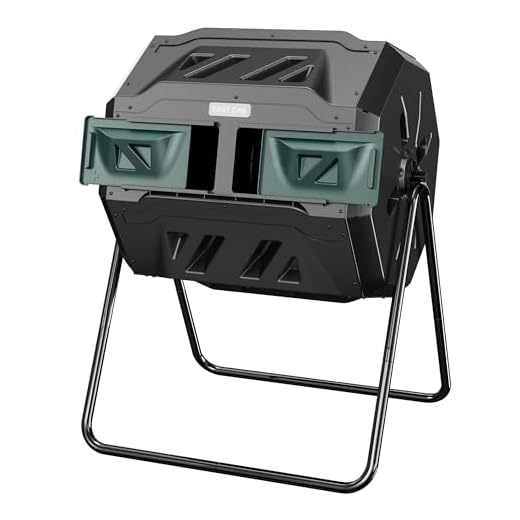
The EAST OAK Outdoor Compost Tumbler is a sturdy, space-saving solution for turning kitchen scraps and garden waste into nutrient-rich compost.
With its dual-chamber design, smooth rotation, and strong construction, it provides an efficient and practical way to speed up composting while fitting neatly into patios and small gardens.
When we assembled the EAST OAK tumbler, we quickly saw that it required patience and ideally two people. Once in place, however, it felt strong and secure. The rotation was smooth, and adding scraps was simple with the sliding doors.
We also noticed liquid draining naturally, which we collected for use as compost tea. The airflow system worked effectively, avoiding unpleasant smells and keeping the mix aerated.
Within weeks of regular turning and maintaining the right balance of greens and browns, we saw a clear reduction in volume and consistent composting progress. The black panels retained warmth well, helping speed up the breakdown.
While it isn’t watertight, this prevents sogginess and improves results. For us, the process was straightforward, and after a month, we had usable compost ready for the beds.
The EAST OAK tumbler is a reliable, efficient, and well-designed composter that we found ideal for creating rich soil with minimal effort.

The SQUEEZE Master 130L Garden Tumbling Composter is a reliable option for gardeners who want an efficient and manageable composting system. Its durable construction, simple assembly, and unique liquid collection feature make it both practical and sustainable.
When we tested the SQUEEZE Master, we appreciated its compact yet practical size, making it suitable for a medium garden without dominating space. The rotating drum was easy to turn, ensuring materials mixed evenly and composted quickly.
Assembly was uncomplicated, requiring little more than a screwdriver, and once set up, it felt solid and well-constructed. We found the liquid collection funnel particularly useful, as it allowed us to repurpose compost tea for fertilising plants.
The build quality felt sturdy enough to withstand regular use and unpredictable weather, giving confidence in its longevity. Filling and emptying were manageable without strain, and the hatch design provided easy access to finished compost.
Overall, this composter performed well in speeding up the process and reducing the workload. For gardeners seeking an eco-friendly, efficient, and thoughtfully designed tumbler, the SQUEEZE Master 130L is a worthy runner-up that delivers dependable results.

The Dripex 160L Dual Chamber Composter is an affordable and practical solution for gardeners who want efficient composting without heavy manual work.
It combines a generous capacity with a sturdy build, offering an accessible way to recycle kitchen and garden waste while producing rich compost in a shorter time.
Setting up the Dripex requires some patience. With many screws and a centre divider that takes careful alignment, assembly is smoother with two people. Once built, the frame feels robust, and the barrel rotates smoothly.
At 160 litres, the bin provides ample capacity for regular kitchen scraps and lawn clippings. Within a few weeks of use, we noticed compost breaking down into a fine, earthy mix. The ventilation system works effectively, with no foul odours and minimal effort required to maintain balance.
We found the raised design convenient, especially when paired with a tray underneath to collect nutrient-rich liquid. The inclusion of gloves is a thoughtful touch, making handling cleaner and more practical.
Overall, the Dripex strikes a strong balance between cost and performance. For gardeners who want reliable composting without investing in premium models, it is a sturdy, functional, and budget-friendly choice that delivers consistent results.

The FCMP Outdoor IM4000 is a reliable choice for those new to composting. With a dual-chamber system and an easy-to-turn design, it makes producing healthy compost simple.
Its compact build, accessible loading doors, and sturdy construction mean beginners can quickly achieve results without the challenges of managing a traditional compost heap.
We recently tested the FCMP Outdoor IM4000 and found it well-suited to beginners who want straightforward composting. The tumbler’s dual chambers make it possible to keep composting continuously, avoiding the downtime of waiting for one batch to finish.
The large openings make adding food waste easy, and the removable door allows quick access when compost is ready to use. We appreciated the elevated design, which keeps pests away and adds convenience in smaller gardens.
While assembly involves multiple nuts and bolts, the process is manageable with patience and the online instructions are clear. Once in use, the composter feels sturdy and produces results quickly in the right conditions.
Turning is smooth when rotated regularly, although it can feel heavier if left to fill completely. Overall, it is an effective and accessible way to start composting at home, balancing ease of use, speed, and durability.

The GiantexUK 160L Garden Tumbling Composter is built for efficiency, making it an excellent choice for gardeners who want quick results with minimal effort.
With a double chamber system, sturdy construction, and effective aeration, it transforms kitchen scraps and garden waste into nutrient-rich compost faster than static bins.
We tested the GiantexUK 160L Composter over several weeks and were impressed with its performance. Once filled, it heated up quickly, which is crucial for breaking down waste at a rapid rate.
The tumbling system worked smoothly, and rotating the drum only required light effort, keeping everything evenly mixed.
The two-chamber system proved particularly useful. While one side was still processing, we could load new material into the other, avoiding delays and keeping the cycle continuous. This design made it easier to produce a steady flow of compost for our beds.
We also found the build quality to be solid. The reinforced frame kept the composter stable, and the panels retained warmth even during cooler weather. While assembly required some patience, the end result was a robust, practical tool that suits both small and medium-sized gardens.
The GiantexUK 160L Garden Tumbling Composter is our pick for efficiency. With its dual chambers, strong build, and aeration-focused design, it’s an ideal solution for producing compost faster and with less effort.

We’ve spent enough time with the COSTWAY 160L composter to know it’s one to avoid. The first issue comes before you even get started; assembly is an absolute headache. With dozens of small nuts and bolts and vague instructions, it felt more like an endurance test than setting up a garden tool.
Even once assembled, not everything fits neatly, and that left us questioning the design from the outset. The dual chambers sound great in theory, and yes, having 80L per side offers generous capacity.
The frame itself feels sturdy, and the plastic panels seem durable enough to withstand the weather (we did like that the structure didn’t wobble). Unfortunately, these positives are overshadowed by practical frustrations. The sliding doors are far too small, making loading and unloading a messy chore.
Rotating the barrel, while smooth at first, quickly becomes heavy and difficult once material builds up. Performance is also disappointing.
Despite the ventilation holes, the composting process drags on much longer than promised, and it’s easy to end up with soggy, unusable waste instead of rich compost.
For us, the effort required far outweighs the benefits. In the end, no matter how durable the frame might be, this composter caused more frustration than results.
When evaluating tumbler composters, we didn’t just spin them a few times and call it a day. We tested them in real garden conditions to see how well they performed over time. Here’s how we did it:
We evaluated the ease of assembly for each composter, assessing the clarity of the instructions, the number of screws and parts, and whether basic tools were sufficient. We also checked the initial stability once fully assembled to see if it felt secure and ready for use.
Practicality was key here. We tested how simple it was to load kitchen scraps and green waste, whether the doors or hatches were a convenient size, and how easy it was to remove finished compost. Rotation was another factor—some turn smoothly when empty, but become difficult once filled.
We also considered the footprint, looking at how well each model fit into different spaces, from patios to larger gardens.
To measure real results, we tracked composting speed over several weeks, noting how quickly materials broke down into usable compost. Ventilation and odour control were monitored to see if the designs kept mixtures aerated and fresh-smelling.
We also assessed temperature retention, particularly whether dark panels or insulated designs helped accelerate decomposition.
We tested how each composter handled exposure to rain, sun, and frost. Material quality was key, so we checked for signs of warping plastic or rusting steel. Structural integrity was also evaluated—did the frame wobble or weaken when close to capacity, or did it remain stable under pressure?
Some models offered more than just the basics. We tested liquid drainage systems for collecting compost tea, dual-chamber setups for continuous composting, and user-friendly additions like ergonomic heights and easy-clean designs.
Maintenance needs were also reviewed to see how often adjustments or cleaning were required.
Finally, we compared each model’s price to its performance, weighing cost against durability, ease of use, and composting speed. We factored in the overall user experience to highlight which composters truly delivered value for money.
Tumbling composters don’t require worms to function, as the rotation and aeration create the right conditions for decomposition. Microorganisms naturally present in food and organic waste do most of the work.
Worms can speed up the process, but they’re not essential for producing nutrient-rich compost.
When managed correctly, tumbling composters should not smell bad. Proper aeration, balanced green and brown materials, and regular rotation keep the mixture fresh. A healthy composter typically smells earthy rather than foul.
Odours usually indicate too much moisture, poor airflow, or an imbalance in the composting materials.
A tumbling composter should be placed in a sunny or partially sunny spot to help retain warmth and speed up decomposition. It should rest on level ground for stability and be located conveniently near the kitchen or garden. Good airflow around the bin also enhances performance.
Yes, coffee grounds can be added to a worm bin in moderation. They provide nitrogen, which helps balance carbon-rich materials. However, too many grounds can make the environment too acidic. Mixing them with shredded paper or dry leaves helps maintain a healthy balance for the worms.
Composting in a tumbler is faster than in traditional compost piles, typically taking anywhere from four weeks to three months. The exact time depends on factors like temperature, rotation frequency, and the balance of greens and browns. Regular turning and proper moisture levels help speed up the process.
Hopefully, you’ve found our guide to the best tumbler composters for fast results both useful and practical in helping you choose the right model for your garden.
With so many options available, it can be tricky to know which one will truly deliver rich compost without the hassle—but we’ve tested and reviewed the top performers for you. Out of all the models we looked at, the EAST OAK Outdoor Compost Tumbler is our clear Editor’s Pick.
Its sturdy dual-chamber design, smooth rotation, and reliable aeration make composting easy, efficient, and fast, perfect for small spaces or patios.
That said, both the SQUEEZE Master 130L and the Dripex 160L are strong alternatives if you want durability, eco-friendly features, or budget-friendly performance. One model we don’t recommend is the COSTWAY 160L, which caused more frustration than results.
What do you think of our top picks? Share your thoughts below, we’d love to hear from you!

If you want a job doing, Jeff’s your man. Our all-around resident man on the tools, Jeff’s shirt is always covered in paint and his coffee is never without wood chippings. Always on the go and a fully qualified joiner, Jeff is a professional reviewer and has great knowledge about tools, design, installation and is a force to be reckoned with